What are ear tags & NLIS tags and why are ear tags used on sheep and cattle?
The below information covers a lot of basic information about using ear tags in cattle, calves, sheep, lambs, goats and kids in Australia both management (visual) ear tags and NLIS ear tags (electronic NLIS tags).
Table of Contents:
- What’s the purpose of livestock ear tags? Why are ear tags put on cattle, sheep and goats?
- Why do farmers and others want to visually identify their livestock?
- What are NLIS ear tags used for? Is NLIS compulsory?
- What does a NLIS tag look like?
- Are NLIS ear tags the same as visual/management ear tags?
- Are NLIS tags electronic?
- What does a cattle management tag look like?
- Why are cattle and sheep NLIS tags different?
- NLIS cattle tagging rules
- Which ear do cattle tags go in?
- NLIS sheep & goat tagging rules
- Which ear do sheep tags go in?
- Ear tag year colours for sheep
- Ear tag year colours for cattle
- Cattle freeze brand letter year system
- How is the Victorian NLIS system different from other states?
- What can you print on a cow or sheep tag?
- Why do cattle and sheep electronic tags have 2 different numbers? How do ear tag readers read the numbers?
- Are sheep and cattle ear tags used for other purposes?
- Is it mandatory for NLIS sheep tags to be electronic?
- Details of the different eID sheep tag discount programs by state
What’s the purpose of livestock ear tags? Why are ear tags put on cattle, sheep and goats? Why do farm animals have ear tags?
There are two main purposes of sheep, goat and cattle ear tags. One is to help farmers and others to visually identify their livestock (management tags), and the other is to comply with Australia’s National Livestock Identification System (NLIS) for traceability and biosecurity (electronic NLIS tags).
Why do farmers and others want to visually identify their livestock?
Not all farmers want to visually identify their livestock. Some farmers will only use NLIS tags and may only apply them when livestock are being moved off their property. Some benefits to using visual ear tags (also known as management tags) from an early age:
- Being able to identify livestock on-farm which can lead to improved and tailored management practices. For example, recording the individual cow numbers of troublesome, difficult birthing, poor mothering or sick cows to cull at a later date. Sheep may have a second tag put into them (e.g. a brown coloured tag) to indicate that they should be culled.
- To indicate sex - often farmers place ear tags in the right ear of female sheep (ewes) and the left ear of male sheep (wethers and rams). This can allow for the rapid drafting of ewe and wether lambs going through a race. Some farmers may use a different ear tag colour for wether and terminal lambs which will be sold. Using different coloured lamb ear tags allows wether and terminal lambs that have gotten through fences and mixed in with ewe lamb mobs to be easily identified in the paddock and caught.
- To indicate year of birth - it is recommended to use a different colour of ear tag for each year. This makes it easy for you to know the year of birth of your livestock without needing to catch or crush them and check their teeth. Using the recommended year tag colour (White for 2025, Orange for 2026 & Light Green for 2027 etc) can also make it easier for livestock buyers (sale yard buyers, ewe buyers etc) to know the age of your livestock as these common year colours are used by the majority of commercial farmers.
- To indicate sire (and dam) or breed type - This can be done with a second different colour ear tag, or by using different types of ear tags or by including numbers on ear tags. For example by using Leader Multipin ear tags for Cashmore Oaklea composite sheep and using Leader Multitronic ear tags for Lambpro Primeline composite sheep.
- To indicate single, twin or triplet bearing sheep - whilst electronic ear tags may be more suited to this task, additional visual tags can still be used for quick on-farm identification.
- To look professional - farmers selling sheep or cattle at auction or ram or bull studs can have their livestock looking more professional with their farm name printed on their ear tags.
- For neighbours, council officers and others to easily recognise who straying sheep or cattle belong to and so they can easily help return them home.
What are NLIS ear tags used for? Is NLIS compulsory?
NLIS ear tags are legally required to be on cattle, sheep and goats before they are moved from their property of birth under Australia’s National Livestock Identification System (NLIS) rules. This usually means before they leave the farm on their way to abattoirs, feedlots, auction yards, or to other farms. However it is common for NLIS ear tags to be applied to young livestock such as when they are marked - well before they will leave their property of birth.
NLIS ear tags help with the identification and traceability of cattle, sheep and goats. The system combines three elements:
- All cattle, sheep and goats are identified with a visual or electronic ear tag.
- All properties and physical locations where livestock move through are identified with a unique identification code known as a Property Identification Code (PIC)
- All livestock location data and livestock movements are recorded in a central database.
What does a NLIS tag look like?
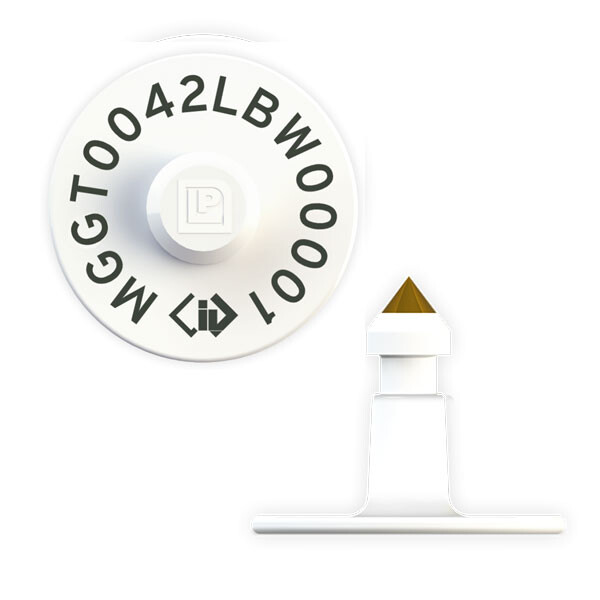
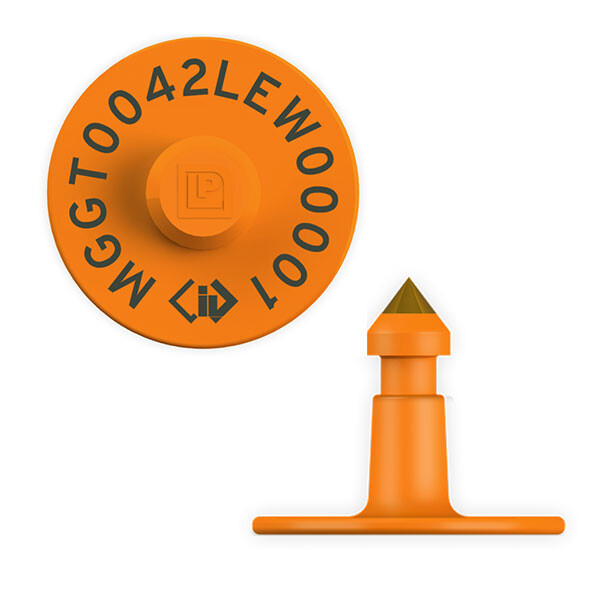
NLIS Cattle Tag & NLIS Sheep Tag Photos:
|
|
| NLIS White Breeder Cattle Tag | NLIS Orange Post Breeder Cattle Tag |

|

|
| NLIS Sheep Z Tags TagFaster | NLIS Sheep Leader Multipin |
Are NLIS ear tags the same as visual (management) ear tags? Why do some cattle have two ear tags?
NLIS ear tags for cattle are not a visual ear tag. They are small round electronic tags (white or orange). Whilst they do have the PIC number printed on them, the writing is too small to read once the tag is applied to the cow. Farmers wanting to visually identify their cattle, need to also apply a second management ear tag (visual tag) - usually to the other ear of the cow.
NLIS ear tags for sheep and goats are now electronic and are technically no longer classified as visual ear tags. However, because they look almost identical to the previous non-electronic version, farmers still use them for both visual identification and electronic scanning. They follow the same year-colour system and have the Property Identification Code (PIC) printed on them, just like the non-electronic NLIS tags used for sheep and goats born before 1 January 2025. In practice, these new tags are dual-purpose - suitable for visual identification and compatible with electronic reading equipment.
Are NLIS tags electronic?
- Cattle - Yes. All NLIS cattle tags are electronic (eID).
- Sheep and Goats - Sheep and goats born on or after 1 January 2025 must have electronic (eID) tags. Animals born before this date may continue to use visual tags.
What does a cattle management tag look like (also known as a visual cattle ear tag)?

Cattle management tags most commonly include the farm name and consecutive numbers. They also commonly just have consecutive numbers. Some farmers also like to include their phone number or name on them.
Why are cattle and sheep NLIS tags different?
Cattle have long used electronic NLIS tags because disease traceability and export market demands arose first for beef, and it was economically and logistically easier to implement on a per-head basis than for sheep and goats.
Electronic NLIS tags for sheep and goats are newer and have been designed in the same year colours and similar shapes as the visual NLIS tags they replace. This design allows the new tags to serve a dual purpose — providing clear visual identification while also being compatible with electronic reading equipment.
NLIS ear tags for cows - What are the cattle tagging rules?
Cattle must be tagged with an electronic NLIS cattle tag before being moved off their property of birth. The tag should be applied to the cow’s right ear. Everything ID recommends the Leader NLIS Enviro Cattle Tag for retention and read distance.
Two types of NLIS cattle tags are commonly used:
- White tags (NLIS breeder cattle eartags) - applied to cattle born on the property before they leave.
- Orange tags (NLIS post-breeder cattle eartags) - used on introduced cattle (not property bred) who have lost their original tag.
Only one electronic NLIS cattle tag should be present on a cow at any one time. Post-breeder tags are for non-property-bred animals without their original tag.
Which ear do cattle tags go in?
NLIS cattle ear tags must be placed in the cattle's right ear. This is a NLIS requirement so that abattoirs and saleyards can setup their RFID reading equipment as effectively as possible. This means that management cattle ear tags are normally placed in the opposite ear - the cow's left ear.
NLIS ear tags for sheep and goats - What are the sheep and goat tagging rules?
Sheep, lambs, goats and kids must be tagged with an NLIS tag before being moved off their property of birth. For sheep and goats born on or after 1 January 2025, this tag must be an electronic NLIS tag (eID tag). For animals born before this date, either an electronic or a visual NLIS tag may be used.
NLIS sheep and goat tags can be any of the eight standard NLIS ear tag colours, except pink, which is reserved for post-breeder tags. It is recommended to use the tag colour that corresponds to the commonly recognised year-of-birth colour system (see more information below).
Everything ID stocks leading NLIS tag brands, including Leader, Z Tags and Allflex.
Which ear do sheep tags go in? Which ear do you tag lambs?
It is common practice by Australian farmers for sheep ear tags to be placed in the right ear for females and the left ear for males. Some states such as WA have this as a requirement whilst other states allow ear tags to be placed in either ear regardless of sex.
Ear tags are most often applied to sheep whilst they are lambs - more often at lamb marking time, but also at weaning time. Lamb ear tags are attached to the right ear for ewe lambs, and to the left ear for wether lambs. Some farmers remember this by joking that ewes are always right. Although if applying ear tags at lamb marking time in a cradle, whilst it will be the lambs right ear, it will be the left ear facing the farmer that the lamb eartag is applied to. Not all farmers apply lamb ear tags like this though - some do the opposite. Some farmers may also use other methods such as using different coloured lamb ear tags for male and female lambs and others may tag terminal lambs as wether lambs regardless of sex.
Ear tag colours for sheep - what do the different colour ear tags mean?
Australian producers commonly follow an eight-year rotating colour system so the year of birth is quickly visible. These colours are widely used in commercial operations to help buyers and producers quickly estimate age. The common colour cycle is shown below. The colours rotate in an eight-year cycle because it is uncommon for commercial farmers to keep sheep older than eight years.
However, the colour system is a recommendation only (except in Western Australia) and isn’t compulsory. Reasons for not following the colour system include: only having a small number of sheep and not needing to identify by age, using leftover tags from previous years, and choosing colours for management or property reasons (e.g., matching existing mob colours, distinguishing flocks, or aligning with other on-farm ID systems).

Typical colour mapping used by many farms:
- White: 2017, 2025
- Orange: 2018, 2026
- Green: 2019, 2027
- Purple: 2020, 2028
- Yellow: 2021, 2029
- Red: 2022, 2030
- Blue: 2023, 2031
- Black: 2024, 2032
- Pink: Post-breeder tags (any year)
Ear tag colours for cattle - what do the different colour ear tags mean?
It is becoming more popular for cattle farmers to use cattle visual tags that also are based on the same colour of the year system as sheep (8 colours - see above table). Other cattle farmers may instead just use the one colour of ear tags and yellow is the most common colour for cattle ear tags followed by white and orange.
Note that for the electronic NLIS cattle tags, there is no choice of colour. White tags must be used for breeder cow tags, and orange tags for post breeder cow tags.
What about freeze branding? Cattle freeze brand letter year system
Freeze branding is another excellent way of identifying cattle and is a permanent indentification method. It is commonly used by bull breeders and farms registering their cattle with associations such as Angus Australia & Herefords Australia. A standard system has been adopted in Australia where a letter represents the year of birth. Please find the below table showing the associated year letter codes.
| Year | Letter |
|---|---|
| 2005 | A |
| 2006 | B |
| 2007 | C |
| 2008 | D |
| 2009 | E |
| 2010 | F |
| 2011 | G |
| 2012 | H |
| 2013 | J |
| 2014 | K |
| 2015 | L |
| 2016 | M |
| 2017 | N |
| 2018 | P |
| 2019 | Q |
| 2020 | R |
| 2021 | S |
| 2022 | T |
| 2023 | U |
| 2024 | V |
| 2025 | W |
| 2026 | X |
| 2027 | Y |
| 2028 | Z |
How is the Victorian NLIS system different from other states?
Victoria introduced electronic NLIS (eID) tags for sheep and goats earlier than other states. Key differences:
- Victoria required eID tags from 2017, compared to 2025 for other states and territories. Other states historically used visual NLIS sheep tags prior to the 2025 national transition.
- In Victoria, NLIS ear tags (for sheep, cattle and goats) must be purchased through the Victorian State Government (Agriculture Victoria). Other types of tags, such as cattle management tags (visual cattle tags), can be purchased from Everything ID.
What can you print on a cow or sheep tag?
That’s your choice. Commonly printed on sheep ear tags and cattle ear tags are:
Cattle management tags:
- Just individual numbers
- Property name and individual numbers
- Property Identification Code (PIC) and individual numbers
Sheep ear tags:
- Just the Property Identification Code (PIC)
- Property name and the PIC
- Individual numbers and the PIC
Why do cattle and sheep electronic tags have 2 different numbers? How do ear tag readers read the numbers?
Electronic NLIS cattle tags like the Leader Envirotag contain two
numbers:
1. A visual number: a 16 character visual
identification number that is printed on the outside of the tag (known as the
NLISID or NLIS number) which starts with the PIC; and
2. An
electronic number: a unique 15 digit RFID number starting with 9 that
is programmed into the tag's chip and is read electronically (RFID number).
Every NLIS cattle tag that is produced has a unique 15 digit RFID number
programmed into it's chip. When you place an order for NLIS cattle tags, the tag
manufacturer (eg. Leader Products) also prints a reference number (NLISID
number) onto the outside of the tag to make it easier for you to visually
identify the tag. This number is not programmed into the tag electronically.
Instead, when you buy the tags, the manufacturer registers both the RFID number
and NLISID number on the NLIS database.
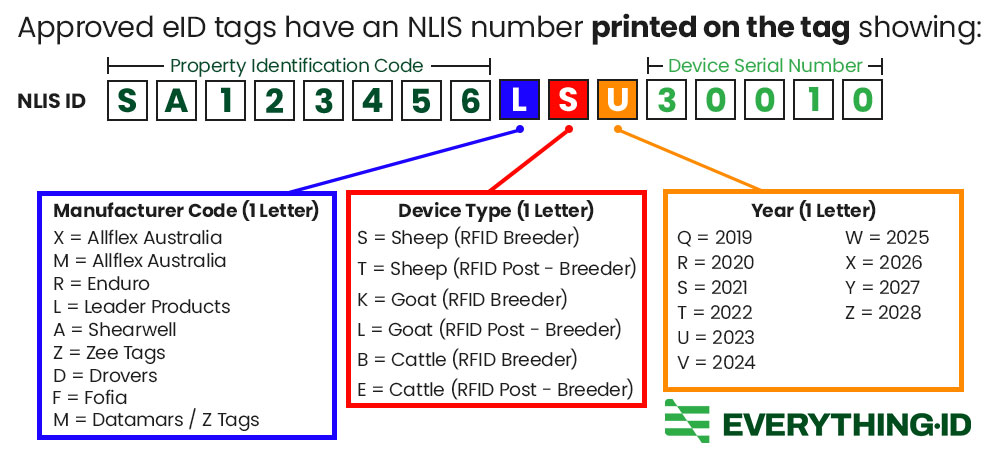
The printed
number (NLISID) number is made up of your PIC number (8 characters) + a 3
character code showing the tag distributor, tag type & year issued + a 5 digit
reference number for you.
- Tag Distributor Code:
- Current Codes: L = Leader Products, X = Allflex, M = Datamars / Z Tags, A = Shearwell, F = Fofia
- Old Codes: D = Drovers, Z = Zee Tags
- Tag Type: B = Cattle Breeder, E = Cattle Post-Breeder, S = Sheep Breeder, T = Sheep Post-Breeder, K = Goat Breeder, L = Goat Post-Breeder
- Year Issued: T= 2022, U = 2023, V = 2024, W = 2025, X = 2026 and so on (same year letters as freeze brand letters in the table above)
As both the NLISID & RFID numbers are linked, when you use the NLIS database, you can enter either the RFID number or the NLISID number for an animal when you submit a transaction, such as moving cattle from one property to another.
When purchasing cattle ear tags from us, in the options, you can select Yes to getting an electronic number list (bucket file):

This will provide you with a spreadsheet showing both the RFID tag number and the corresponding NLISID reference number:

Alternatively, you can login to the NLIS website, select the "View devices on my property" report and it will show you a list of active ear tags on your PIC and it will show both the RFID number and the visual NLISID identification number:

For Allflex eID tags, bucket file spreadsheets showing the printed number (NLISID) and the corresponding RFID number can be downloaded from the Allflex eID Download website at: https://connect.allflex.com.au:8443/eiddownload/
Are sheep and cattle ear tags used for other purposes?
Yes, sheep ear tags aren't just used on sheep and lambs, and cattle ear tags aren't just used on cattle and calves. Ear tags are used for a wide variety of purposes.
Cattle management tags (visual tags) are often used for vineyards, orchards, weddings, events, and more. Sheep visual tags are often used for hat tags, work boot tags and more.
Both cattle and sheep visual tags can also be used for dog tags, key ring tags and plant and equipment tags. The two commonly used tags for dog tags (to print the dog’s name and owner’s contact number on) are (a) Leader Mini Female Cattle Size 5 Tags; and (b) Leader Sheep Multi Tags.
Is it mandatory for NLIS sheep tags to be electronic?
Yes, electronic tags (eID tags) are now mandatory for sheep & goats born from the 1st of January 2025. In 2022 the National Biosecurity Council and state/territory ministers agreed a national pathway for mandatory electronic identification devices (eID) for sheep and goats. The key implementation dates adopted are:
- 1 January 2025 - Sheep and goats born on or after this date require NLIS-accredited electronic (eID) tags for movements off the property of birth.
- 1 January 2027 - National target date for all sheep and goats moving off property to be electronically tagged (this is a target and may be implemented according to state arrangements).
If you are purchasing eID tags in 2025 and beyond, check the available state discount programs available below. Several state rebate schemes continue to operate through 2025-2027 to support producers with the transition.
Details of the different eID sheep tag discount programs by state
| State | Details | Time Period |
|---|---|---|
| WA | WA Sheep & Goat Tag Incentive Payment ($0.60 discount per eID tag) |
* Blue eID tags in 2023 * Black eID tags in 2024 * White eID tags in 2025 * Orange eID tags in 2026 * Pink eID tags in 2026 * Yellow eID tags in 2026 |
| SA | SA Sheep and Goat eID Tag Discount Program ($0.475 per tag) |
* Black eID tags in 2024 * White eID tags in 2025 * Orange eID tags in 2026 * Green eID tags in 2027 (until 30 June 2027) |
| TAS | TAS Sheep & Goat eID Tag Rebate Scheme ($1.00 discount per eID tag) |
* Black eID tags until 30/06/25 * Pink eID tags until 30/06/26 * Yellow eID tags until 30/06/26 * White eID tags 1/11/24 - 30/06/26 * Orange eID tags 1/11/25 - 30/06/26 |
| NSW | NSW Sheep and Goat eID Tag Discount Program ($0.76 discount per eID tag) |
* White eID tags 1/11/24 to 31/12/25 |
